

Where Have All the Good Dates Gone, and What Can We All Do? (Part 3)
It’s not just you. If you are a Gen Z single who would love a significant relationship—or if you are a parent who is wondering why your adult child isn’t out there dating—you need to know that the “dating market” really is in a slowdown.
In Part 1 of this three-part series, we described the groundbreaking findings from a group of researchers about this dating trend—especially the astonishing statistic that among single adults ages 22-35 who want to be married, fully seven in ten have pulled themselves out of the dating market. In Part 2 we described one main reason why so many singles have done that (a lack of confidence in dating-related communication skills) and some simple action steps that could help.
In this final Part 3, we will focus on two other key reasons and action steps for young adult singles (specifically Gen Z singles, since thirtysomething singles have different needs), as well as a few big-picture steps that each of us (yes, even married couples) can take to help get the dating market moving again.
Reason #2: Low resilience after dating setbacks
Dating has always involved risk. No one likes awkwardness, rejection, heartbreak, or simply discovering that a promising connection is not the right fit. That part is not new.
What is different today is how many young adults are being taken out of the process by those experiences.
The research report found that only 28% of the young adult singles were able to stay positive after a bad date or relationship setback. And 55% said that prior breakups had made them more reluctant to step into new opportunities.
That is a big deal. When Gen Z singles are ghosted or hit a real dating setback, it is changing their willingness to re-engage at all.
The hurt is real. But the need for resilience is real, also. So how to build it?
Action #2: Practice learning from setbacks rather than withdrawing
Building resilience with normal ups and downs will help with everything in life, not just dating. The key step is to switch from viewing negative experiences as something to avoid, and instead to think of them as something to learn from. There’s no way around the fact that rejection is always painful. But you can practice thinking about it differently.
Being ghosted is not proof that you are unappealing. It means that one person was rude. (You dodged a bullet!)
A bad date is not proof that there is no one out there. It means that you’ve had a chance to establish what you don’t like in a potential partner—which is almost as valuable as learning what you do like.
In other words, young adult singles can practice using disappointment and hurt feelings to build their character, healthier thinking, and ability to regulate emotions. Which, of course, is not only essential for dating. It matters in marriage as well. It matters in the workplace. Every significant relationship requires the ability to move through discomfort rather than simply flee from it.
Reason #3: Certain expectations that make dating harder
A third reason for the dating recession is something we’ve seen in our own research for years: People sometimes step into relationships with unrealistic or unneeded expectations.
For example, many singles in that 22-35 age range felt they shouldn’t actually pursue marriage-oriented dating until they were totally stable in their finances and career. So they thought, “I want marriage at some point—but I’m not ‘there’ yet.” And that “not yet” often gets pushed back for years.
Others felt like a promising relationship should simply feel effortless quickly, and that awkwardness is always a bad sign—rather than being a sign of normal nerves at meeting a new person. Or they saw one thing as unattractive (“He wore socks with his slip-ons!”), which crowded out the desire to explore further. In real life, though, most healthy relationships develop gradually and get more comfortable in stages.
So what is the lesson here?
Action #3: Adjust expectations without lowering standards
We should never lower expectations for things like character or a shared, sincere, faith. But it’s a good idea to ask if we are majoring on the minors. Not every good relationship is going to start with instant chemistry. Not every person matures at the same rate. Not every awkward start stays that way. And not every hesitation about “not being stable in my career” should hold us back.
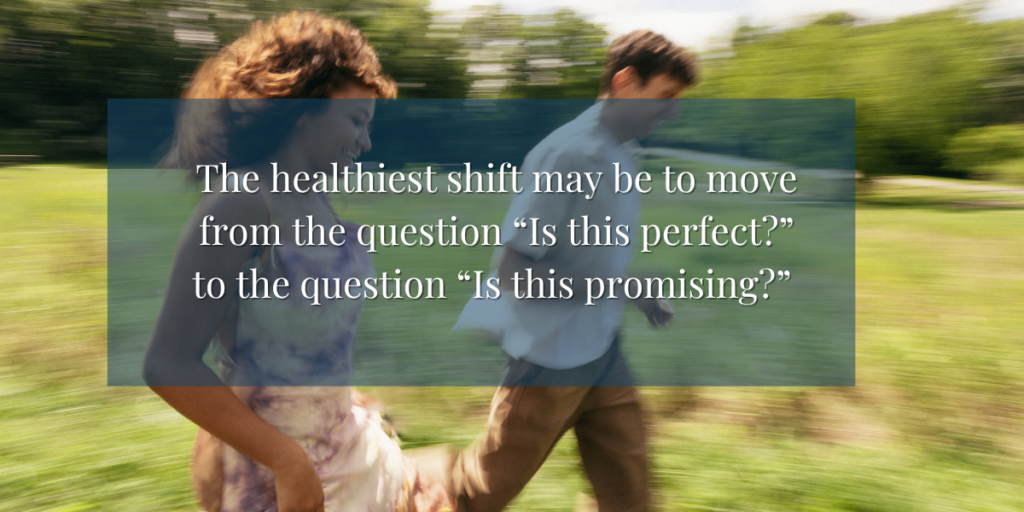
The key is to not dismiss a relationship that might have real potential. The healthiest shift may be to move from the question “Is this perfect?” to the question “Is this promising?” That is a very different lens.
Action Step for Anyone: Ideas for Anyone Who Wants to Help
Here’s the most important big picture takeaway from the “Dating Recession” report: The big picture solution is to help get real activity back into the dating market again—in part by helping Gen Z singles build the confidence that they can do it, and it is worth it. Here are some ideas for anyone to consider—including those of us who are no longer in our dating years but care about those who are. (And we would love your ideas as well –please take this short for Gen Z singles or this short poll for the older generation.)
Idea 1: Pray
For my readers of faith, praying for the young singles in your life can have enormous impact! Pray that God would provide a spouse for them (if that is their desire). Pray they will not believe lies about “all the good ones being gone” or fears about “being single forever.”
It’s important to understand that our young people are in a battle. So, pray for hope, resiliency, confidence, and opportunity. Pray they will place their faith God—not in advice, apps, or “odds”!
Idea 2: Refuse to add fuel to the fire
If you prod your nephew at every family gathering about why he’s not married or dating, there may be a day when he doesn’t want to come to Thanksgiving dinner anymore. No one wants that outcome. Make sure he (and every young person) in your life knows that they are interesting, complete, invited, and essential in your family or friend group, whether they are single or married, and whether they are dating or not.
Idea 3: Mentor young people
This is an organic way to support young people in your life beyond your family. Connect with a college or young adult ministry as a small group leader and then remain intentionally in their lives. Join (or start) a mentoring program at work, and then be there when real-life issues inevitably come up.
Ask the young person who serves on the greeting team with you if they’d ever like to grab lunch after church. You’d be surprised at how many people want connection with older people who truly care. Most of the time mentoring isn’t going through a book or study together. It’s just time being together in some way. (You’ll see a specific example below.)
Idea 4: Arrange an event
This is a bigger picture idea than can be fully captured in a blog. But since Jeff and I have done so much research on relationship and communication skills—and are now conducting focus groups about this specific dating need—we have been pondering what sort of system might help open up the dating scene in a healthy way.
One idea would start with gathering a team of twenty-something singles and arranging a fun and educational event for them at your church—something they would want to attend. This event should give everyone a chance to not only socialize, but absorb and consider some of the specific learnings we’ve been talking about. Maybe there’s a speaker who can share some basic, confidence-building communication tips. Or a panel of single young men and women might answer questions from the audience about how they think. The options are endless. (Thirty-something singles would likely want a different event, as they will already have learned many of those communication skills along the way.)
Use this event to give people a chance to sign up for Idea 5.
Idea 5: Host a “mentoring” mixed small group
Couples who are already married (including empty nesters who might love to pour into the lives of the next generation) can host a mentoring-oriented small group that includes both single men and single women. Such groups are the perfect place to discuss relationships and mentor one another in important relationship-building skills. The young men and women can not only get to know each other but advise one another. This is a way to practice some of the skills mentioned in Part 2—and get feedback.
The purpose of the small groups would be mentorship, not matchmaking, but who knows what might come of it?
If you are interested in hearing more about this, Jeff and I and some colleagues have been thinking of creating materials that could be used for this sort of process. If you want to be notified when/if we put that together, take this one-minute poll for Gen Z singles or this one-minute poll for parents (potential host couples!) and let us know.
A final word of encouragement to the Gen Z singles out there: You may be navigating a harder dating landscape than previous generations realize. But the “dating recession” does not have to be the last word. It is simply naming a problem that, once understood, can finally be addressed. And you can be part of the solution.
If you are interested in having Shaunti bring research-based strategies, practical wisdom and biblical principles to your next event, please contact Amy Masaschi at [email protected]/.
On our podcast, I Wish You Could Hear This, Jeff and I offer proven steps to help you thrive in your life, faith and relationships. In other words, we’ll offer the practical help you’ve grown accustomed to right here in this blog space. You’ll take away specific steps that help you today. Listen, follow, and share with your friends on YouTube, Apple Podcasts, Spotify and other platforms.
Please note: This post may contain affiliate links. As an Amazon Associate we earn a small amount from qualifying purchases through these affiliate links. This doesn’t cost you anything, and helps us continue bringing you great content!
More from Shaunti’s Blog:
Could Venting Your Anger Actually Be Making It Worse?
Sometimes the worst thing you can do when you’re angry is talk about it. You probably just did a double…What Does Love Look Like When Life Is Wearing You Down?
This is the final part of a four-part blog series about loving people well in marriage, parenting, friendship, or any…How Do You Love Someone Who Is Losing Hope?
This is part three of a four-part blog series about loving people well in marriage, parenting, friendship, or any other…