
Everyday Habits That Build Better Mental Health
Three years ago, I found myself staring at the page of my textbook, stunned. Even after years of research and work around relationships and mental health, it wasn’t until I began my Ph.D. studies that I learned that the anxiety I often dealt with was clinically significant.
It was like a spotlight suddenly illuminated something I’d brushed off for years.
Anxiety often emerged when it came to our kids—especially with regards to our son’s complex form of epilepsy. Luke didn’t have many seizures, as they were controlled by medication, but the epilepsy still caused all sorts of intense learning issues, processing problems, and heartache. It wasn’t until I saw a clear definition of psychological “dysfunction” that I realized my years of worry about it (and disproportionate reactions to it!) totally fit the bill.
As just one minor example, whenever my son’s school called, my heart rate spiked. I pictured him having had a seizure. I began wondering which hospital he was being rushed to and how quickly I could get there. Instead, it was usually something like, “Oh, Mrs. Feldhahn, sorry to bother you but you forgot to sign the permission slip.”
As I sat there reading the textbook that day, truly reckoning with years of examples of anxiety, I also realized: There have to be steps I can take and things I can do about this.
I learned many of those steps while pursuing my Ph.D. in Counseling and Psychological Studies at Regent University. But having spent my whole life as a non-counselor (which I’m still not, as my Ph.D. program was for research and leadership in the field, rather than licensure), I also knew that most people who are hurting don’t have the opportunity to study and sort through academia’s vast knowledge base to find solutions. When someone is feeling helpless about how to fix a challenging marriage, massively stressed at work, buried by grief, or fighting an intense fear of flying as they board an airplane (yet another anxiety that had paralyzed me in the past), they need to have simple and practical principles and practices ready to fall back on.
We have all heard “just trust God” or “try to remain calm” or “you can find joy even in the most difficult circumstances”—but we don’t always know how.
Jeff and I felt like we were being called to investigate and dig out some of the most universal, helpful solutions. Solutions that most mental health professionals already knew and worked on with their clients, but which might be able to bring some degree of hope and healing to the rest of us.
An additional approach to the mental health crisis
As I mentioned in my last blog post, I recently spoke to a group of Christian counseling leaders about today’s spiraling crisis in mental, emotional and relational health—which is due in part to not having nearly enough counselors to care for all those who are hurting. I cast a vision for two additional ways we can address the crisis in the church, pursuing both a “top down” and a “bottom up” approach. Last week I described “top down:” How churches can lead the way in adding peer care for basic mental health issues within the church.
This week we’ll look at something just as important: the bottom-up approach. Just as the church has an opportunity and responsibility to step in and care for those in pain, each of us has an opportunity and responsibility to step up and address our own pain. For example, I have to be willing to not see my tendency toward anxiety as the end of the story and instead take some steps of ownership.
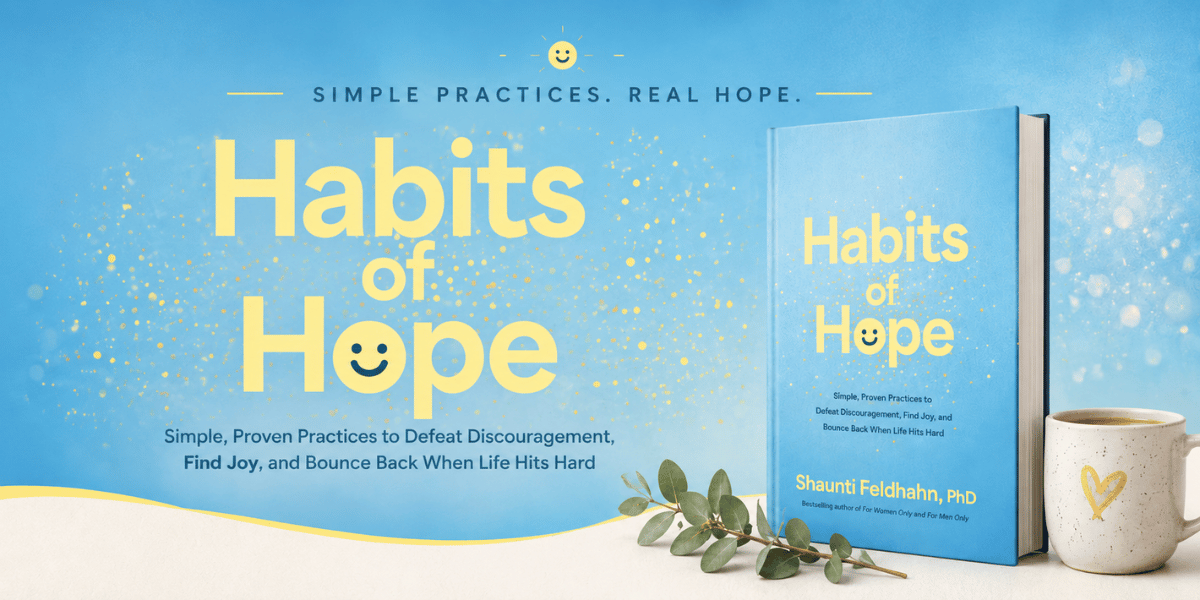
Enter, Habits of Hope—our new book!
Jeff and I identified simple, practical solutions that form the core of an upcoming book that I am incredibly excited about: Habits of Hope. To identify those solutions, we didn’t just dive into forty years of academic studies on what works and what doesn’t (although we did plenty of that). We also spent three years interviewing and surveying the most resilient, hopeful people. People who have dealt with incredible challenges in their lives, relationships and mental health and yet are often joyful and moving forward well despite it all.We wanted to know: What are they doing differently from everyone else? What are their simple habits that build hope?
A sneak peek at the habits
We identified ten day-to-day habits that tended to be common in the lives of these individuals. (Well, actually, we identified twelve, but ten was already pretty long for an easy-to-read book, so we only included ten.) Normally, I would wait until the book is out to publicly share our findings, but I really wanted to share a sneak peek for all of you who are our subscribers!
So here are three of the ten ‘habits of hope.’ The most hopeful people tended to:
- Build a robust structure of support to help deal with troubles. Whether dealing with significant mental health issues, working through marriage heartaches, or simply dealing with the stress and sleeplessness of having young children, the highest-hope people tended to have a system of personal “rules,” practices, and people that held them up when they felt the most fragile. For example, the single mom whose husband abandoned her and their five children knew that she had to plug into an encouraging church small group even though it might sometimes feel like one additional thing on an already-too-full to-do list.
- Look for God’s hand at work in day-to-day life. Even though our main survey was nationally representative, with people of all faith beliefs and none at all, it was fascinating that two of our ten habits explicitly had to do with faith. In this case, we consistently saw that the most hopeful people tended to purposefully look for and see the hand of God (or whatever they thought of as God) at work in their day to day lives. For example, if a student learned something in their college Psychology class on Monday and then a friend had a serious need that required that exact insight on Tuesday, they made the connection. Instead of seeing random coincidence, they saw God continually at work in the day to day, which helped them look for His hand and find peace even when the big issues arose.
- Get comfortable with discomfort. One of the sneakiest cycles that undermines mental health is the tendency to shy away from distress. In years past, when I would avoid taking a flight because I was afraid of flying and instead opt for a grueling seven-hour drive to an event, I thought I was improving my mental health and my mindset. Instead, I was worsening it! I was not learning how to face those fears and overcome them. I was not training my brain to recognize that they could be overcome. And as a result, I was making it worse the next time I had to fly.
These little, practical steps, and the other seven, aren’t magic bullets, and they won’t suddenly solve the big issues. But Jeff and I do hope they make them easier to solve. We also hope that they bring, well, hope, to people who have felt stuck. And after our three years of research, investigation and statistical analysis, we can say that these little things really do appear to make a big difference.
So that’s my “bottom-up” suggestion for helping to address the current crisis. Through simple steps, our hope is that every one of us can feel equipped to pursue some sort of healing around mental and emotional health—whether for our own sake or in order to help those we love.
It’s why I wrote Habits of Hope. One of the deeply encouraging findings to me in this journey was that hope isn’t just something we’re born with. Hope can be built. I invite you to pre-order a copy today, because if there’s one thing we could all use, it’s more hope.
If you are interested in having Shaunti bring research-based strategies, practical wisdom and biblical principles to your next event, please contact Amy Masaschi at [email protected]/.
On our podcast, I Wish You Could Hear This, Jeff and I offer proven steps to help you thrive in your life, faith and relationships. In other words, we’ll offer the practical help you’ve grown accustomed to right here in this blog space. You’ll take away specific steps that help you today. Listen, follow, and share with your friends on YouTube, Apple Podcasts, Spotify and other platforms.
Please note: This post may contain affiliate links. As an Amazon Associate we earn a small amount from qualifying purchases through these affiliate links. This doesn’t cost you anything, and helps us continue bringing you great content!
More from Shaunti’s Blog:
How Do You Love Someone Who Is Losing Hope?
This is part three of a four-part blog series about loving people well in marriage, parenting, friendship, or any other…Do the People You Love Know You Believe in Them?
This is part two of a four-part blog series about loving people well in marriage, parenting, friendship, or any other…When Loving Someone Gets Frustrating: What Does It Mean to Never Give Up?
This is part one of a four-part blog series about loving people well in marriage, parenting, friendship, or any other…