

How To Be More Vulnerable in Marriage (Part 2)
Want to be closer to your spouse? The thing that feels riskiest—vulnerability—is one of the most important moves you can make. And this week we tackle the million-dollar question.
How?
We’ll get to that in a moment. But first, let’s quickly revisit last week’s Part 1 blog on this topic, which illustrated how powerful vulnerability is in creating closeness. In other words, the why. A major study found that a willingness to be open led to greater and greater intimacy in marriage, where a lack of self-disclosure led to a sense of stagnation. (If you haven’t seen Part 1, go back and take a look.)
But how do we “do” vulnerability? While no magic bullet will work in every situation, here are six steps to build vulnerability into your marriage—three this week in Part 2 and the final three in Part 3.
Action step #1: Go first with vulnerability
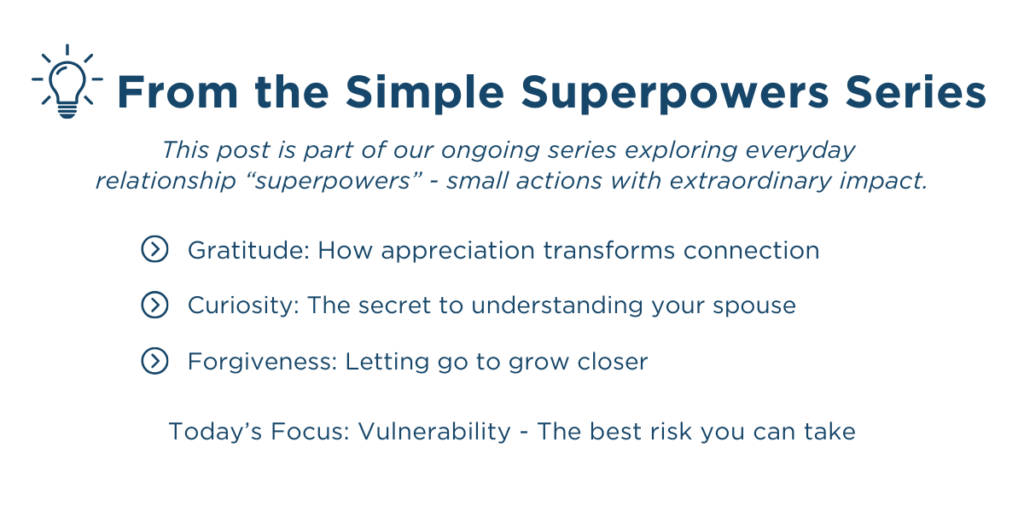
It is easy to think “Ok, I’ll do this . . . once my spouse does.” But in our research about what created great marriages for The Surprising Secrets of Highly Happy Marriages we found someone usually had to go first. And nearly all of the habits that created thriving marriages worked if only one person started doing them. (This principle also holds true for the other habits in this continuing Simple Superpowers series—gratitude, curiosity, and forgiveness).
One of those habits is related to the “vulnerability” topic; the marriages that moved from difficult to delightful made a decision to be “all in” and risk getting their heart hurt without taking steps of self-protection. (This was the case for all but the small number of marriages that were marked by a lack of goodwill and/or abuse, which is beyond the scope of this series. If you find yourself in such a situation, the advice here does not apply, so please seek out the help of a pastor or counselor.)
Opening up can feel like a risk, but it is actually the best risk you can take: Because that one action helps foster greater commitment and (as you saw in Part 1) deeper intimacy. So be the first to go first.
One important note: If vulnerability has been mishandled in the past, and/or if trust has been violated in some way, it’s often best to start small. Yet after a period of healing—and after the person who broke the trust has worked to build it back—it will likely be important to offer grace, take the risk, and start again. Small parts of your heart handled with care can help rebuild the trust essential for offering larger parts of your heart. Get wise advice, keep praying, and give both of you room to grow.
As one counselor friend explained it, “It’s kind of like Jenga. One block (trust) supports another block (vulnerability) and so on, until you have an entire tower. The tower stays strong because it’s set up well, with blocks that strengthen each other. When you start removing blocks—that’s when the tower is at risk of crashing.”
Action step #2: Share one vulnerable thing today
What is it that you’d normally hold back from sharing with your spouse—not because you are trying to keep secrets but because you’re a bit embarrassed to share it? Guys, maybe you’re nervous to reach over and hug your wife and say “Yeah, it’s you,” when a song comes on that reminds you of how beautiful she is (even though that would make her swoon). Why? Because that means wearing your heart on your sleeve, and you’re not used to doing that!
Or wives, maybe you’re equally nervous to praise your man in public (even though there is almost nothing that thrills him more) because you’re worried your words might get jumbled and not come out right.
Maybe you don’t want to “bother” your spouse. Or you don’t think they would care about a challenging work-related matter. Or maybe you’re simply worried that your mate will overreact to whatever you share.
Take the risk to share it, as the first step of building closeness.
For example, suppose you’re that husband from Part 1 who has been holding back on mentioning that you had to drop out of the push-up challenge with the guys at work. You are concerned about why your back is hurting again. And you suspect that your wife may get on you about seeing the orthopedist. You’d prefer to try some stretches and figure it out on your own.
But you now realize your wife would want to know. You also saw in Part 1 that for men the very act of self-disclosure is likely to increase intimacy regardless of the type of response you get. So take the risk to share it. Even take the risk to share that you had been holding back because it feels vulnerable for you. Tell her what you are hoping for in the process. (“I want to tell you about this, but I was holding back because honestly, I think you might keep asking me to go the doctor. And right now I’m hoping you’ll be supportive of me starting with some exercises on my own first.”)
Then look for other things you can share in the days and weeks to come. These small disclosures, stacked one on top of another, create a foundation of closeness you can build on every day.
Action step #3: Respond to your spouse’s vulnerability without reactivity, ‘fixing,’ or judgment
As you might guess from the example of the husband with the back pain, this one step is where vulnerability either opens the door for intimacy, or slams it firmly shut.
So here are two vital cautions about how to respond to whatever is shared with you—each of which present two opportunities for building closeness.
First, validate and listen, don’t fix or dismiss. This is key for everyone. But as you might guess, it’s especially a superpower for a man to help his wife feel loved. In our book For Men Only we have a whole chapter from our study about what women usually are looking for when they share things—including listening to their feelings, first, without trying to fix. Once you’ve pulled out the feelings (“I’m so sorry that your boss said that to you in front of the whole team. Did you feel embarrassed…?”) and she has felt heard, then you can (carefully) put on your Mr. Fix-It hat.(“Would it help to strategize about what to say when you talk to your boss tomorrow?”)
Second, don’t allow a knee-jerk reaction that makes your spouse feel judged or pressured. This, too, is key for everyone. But it is especially a superpower for a woman to make her man feel cared for—and for him to feel able to open up the next time. In our book For Women Only we have a whole chapter from our study about what men are looking for when they share things. Ladies, this includes being reassured that you appreciate them and honor their judgment and efforts.
This doesn’t mean you cannot disagree or share concerns. But when your husband shares that he dropped out of the office push-up challenge because his back has been hurting, respond in much the same way you would want him to: with listening, affirmation, and care. “Thank you for telling me. I know really enjoyed the challenge and I’m so sorry you had to drop out.”
Maybe ask how he feels about that, then give him the space to think about it and respond. You may instinctively want to ask him to make a medical appointment even if he is reluctant. But as you avoid reactivity and demonstrate respect for his judgment (“I’d like to wait a few weeks”) it will make it more likely that he will be willing to avoid his own reactivity and defensiveness about the issue!
Bottom line, regardless of the topic, regardless of who is saying what, just remember that your openness creates space for your spouse’s. Join me in the final blog for three more steps to build vulnerability and bring you closer!
If you are interested in having Shaunti bring research-based strategies, practical wisdom and biblical principles to your next event, please contact Amy Masaschi at [email protected]/.
On our podcast, I Wish You Could Hear This, Jeff and I offer proven steps to help you thrive in your life, faith and relationships. In other words, we’ll offer the practical help you’ve grown accustomed to right here in this blog space. You’ll take away specific steps that help you today. Listen, follow, and share with your friends on YouTube, Apple Podcasts, Spotify and other platforms.
Please note: This post may contain affiliate links. As an Amazon Associate we earn a small amount from qualifying purchases through these affiliate links. This doesn’t cost you anything, and helps us continue bringing you great content!
More from Shaunti’s Blog:
What Does Love Look Like When Life Is Wearing You Down?
This is the final part of a four-part blog series about loving people well in marriage, parenting, friendship, or any…How Do You Love Someone Who Is Losing Hope?
This is part three of a four-part blog series about loving people well in marriage, parenting, friendship, or any other…Do the People You Love Know You Believe in Them?
This is part two of a four-part blog series about loving people well in marriage, parenting, friendship, or any other…