
The Little Phrase that Makes a Big Difference in Marriage
We all have superpowers in marriage. Yours might be to whip up your spouse’s favorite double-decker chocolate cake on their birthday. Others might binge-watch every movie in the MCU in order with their Marvel-junkie spouse (wait, that’s actually me) even though they’d rather have their nose in a book or under the hood of a car.
But every one of us can…
Wait for it…
Say we’re sorry.
Apologizing to our spouse when we’re wrong is a superpower. Yet many of us either don’t think about it—or have an almost knee-jerk reaction against it. Have you ever seen those GIFs or video clips of The Fonz from the old show, Happy Days, trying to apologize? It is hilarious to watch him contorting his face as he physically tries to utter the words: “I was wrr…I was wrrng.”
Saying “I’m sorry” is so important that I’m including this as the latest installment of the Simple Superpower series. This was our highest-read series of blogs from 2024, and it included blogs on gratitude, curiosity, and forgiveness. Last year we added vulnerability (parts one, two, and three). And now it’s time for “I’m sorry” to take its turn.
The “S” word is the next superpower because it creates impact far beyond the moment itself. It removes the toxins that poison a marriage and instead creates conditions for thriving.
So with that in mind, here are four things that many of us completely miss about the alchemy of apology, and the ingredients that will help make this practice a powerful part of your life and marriage.
Humility is sexy. Yes, really.
One of my friends relayed a story about her husband the other day. He was having lower back issues and feeling vulnerable about a test the doctor ordered. A veteran of spine issues herself, she immediately said, “Why did he order that test? That won’t really tell us what we need to know.”
Her husband’s face fell. A few minutes later, he left the room. And she realized what she’d done. He was fearful, and she was in fix-it analysis mode. (Don’t ever believe the stereotype that it is only men who don’t really listen!)
She tried to talk herself out of having to say she was sorry. After all, she hadn’t meant to come across as uncaring, right? But ultimately, my friend went to her husband and owned it. “I know you’re feeling vulnerable, and you needed encouragement. I don’t know why I swoop in with know-it-all statements like that. I’m working on it. Please forgive me.”
His whole demeanor changed, and they ended up going out to dinner that night and having a really good time. Who knew that lowering our pride could be so attractive?
King Solomon wisely said in Proverbs 15:33 that “humility comes before honor.” In other words, humility is a way for us to lift one another up. And as our Secrets of Sex and Marriage research demonstrated, that posture is powerfully attractive.
Sincerity matters in our “sorry.”
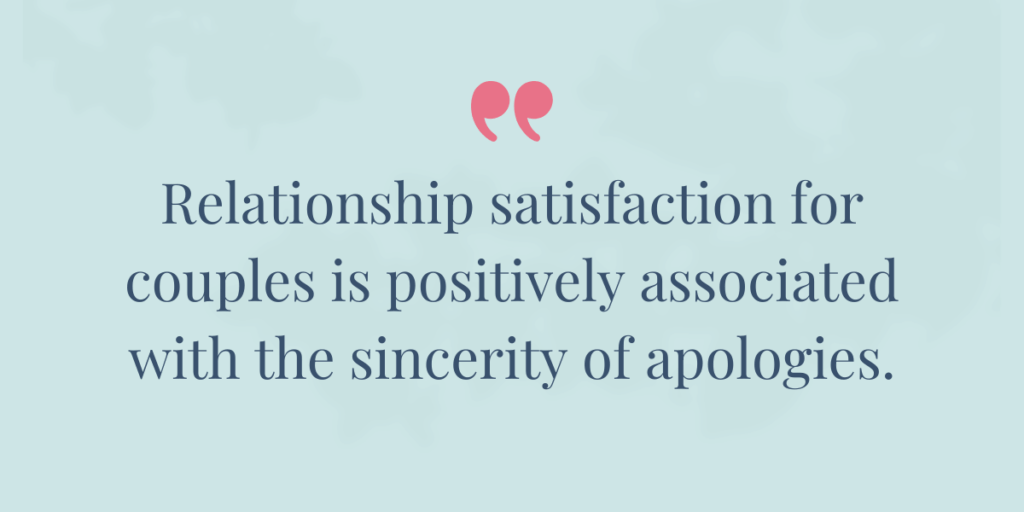
We’ve all heard a half-hearted or obligatory apology. I shudder to consider how many times I’ve given one. Sincerity is our second and equally necessary ingredient for saying “I’m sorry.” In fact, a study in the Journal of Social and Personal Relationships found that relationship satisfaction for couples is positively associated with the sincerity of apologies. In other words: As our apologies become more sincere, our marriage becomes happier.
Here’s the problem: how many of us have proclaimed “I’m sorry!” to end an argument, rather than as a way to take responsibility? But how do we feel when our spouse does that to us? It almost makes it worse than if they hadn’t said anything, doesn’t it?
Here’s why. Your critical words, your cold silence, or your teasing your spouse in front of friends regarding something they are sensitive about is like introducing poison into their system. And the only thing you can do to pull it out of circulation is to take responsibility.
This does not mean you accept responsibility for something that is not yours to own. But it does mean you demonstrate your sincerity by both accepting ownership for your part and your willingness to make a correction.
When we truly mean our words of apology, this can build a bridge back to our spouse in a powerful way. And then it is up to them to take a step across that bridge and offer forgiveness.
Commit to behavior change.
The most effective “I’m sorry” is followed by a willingness to change. If we continually apologize but don’t adjust our behavior, our apologies eventually will sound—and be—hollow. Trust will be questioned, not cultivated. Toxicity will build. The relationship may even start to feel unsafe. This is the last thing most couples want.
So be honest with yourself: Have you been avoiding doing the work of actual change, like getting better at apologizing, or avoiding things that hurt in the first place? If there’s a gap between what your behavior is and what it should be, don’t let it go any longer. Seek supportive help through a friend or mentor who is willing to be honest (“Um, yeah, that was another example of you sounding awfully critical”), a church counseling or trained listener program, or even a clinical counselor who can help address deeper issues.
Reconnect.
The final ingredient is to pursue a step of reconnection after you’ve hurt your spouse and sincerely apologized. Our research for The Surprising Secrets of Highly Happy Marriages found that 70% of the most highly happily married couples have ways of signaling “we’re okay” after conflict—a way of telling their spouse that they’re sorry for the disconnection and they want to make up. For some couples it was a certain touch, for others it was a particular look or gesture. Often it was actually a reference to a shared inside joke.
Whatever you’ve got in your bag of tricks, now is no time to hide it! Signal in some way to your spouse that you’re contrite and you want to reconnect—because they mean everything to you.
Working on this blog reminded me of a classic movie line that couldn’t be further from the truth: “Love means never having to say you’re sorry.”
That’s so wrong! Love means always being ready to say you’re sorry when you’ve caused hurt feelings or harm. The Apostle Paul stated this truth in I Corinthians 13:7: “Love always protects, always trusts, always hopes, and always perseveres.”
Let’s nurture that kind of love and create those conditions that will allow our marriage to thrive. Which starts with setting aside our inner Fonz and sincerely telling the person we love, “I was wrong.”
If you are interested in having Shaunti bring research-based strategies, practical wisdom and biblical principles to your next event, please contact Amy Masaschi at [email protected]/.
On our podcast, I Wish You Could Hear This, Jeff and I offer proven steps to help you thrive in your life, faith and relationships. In other words, we’ll offer the practical help you’ve grown accustomed to right here in this blog space. You’ll take away specific steps that help you today. Listen, follow, and share with your friends on YouTube, Apple Podcasts, Spotify and other platforms.
Please note: This post may contain affiliate links. As an Amazon Associate we earn a small amount from qualifying purchases through these affiliate links. This doesn’t cost you anything, and helps us continue bringing you great content!
More from Shaunti’s Blog:
What Our Families Really Yearn For (It Isn’t More Screen Time)
I’m a self-professed data junkie. But I also understand that the most impressive statistics fall flat without the power of…3 Ways to Send Your Kids Back to School with Confidence
There’s something special about the start of a new school year. New backpacks. Fresh notebooks. First-day outfits laid out the…Happy Birthday, Shaunti!
Today is Shaunti’s birthday (cue the Rachel and Phoebe jumping-up-and-down gif from Friends)! So, we, some of her long-running staff,…