
How to believe the best of someone you strongly disagree with (part 1)
Today is Election Day. And while it may not be a presidential election year, I think we can all agree that the last few months have seen emotions running very high. You have probably been bombarded with hundreds of political ads, social media posts, text messages, and big colorful mailers about the benefits of the people and policies you agree with—and the faults and idiocies of the people and policies you disagree with.
I’ve actually seen a few ads that are quite beautiful. But far more often, election season brings out our not-so-beautiful side…which is something I think we need to strongly challenge today.
It’s pretty easy to be kind and pleasant to people who think like us and to stay in our little bubbles of agreement. After all, there’s nothing quite like the feeling of having our strongest convictions validated by another person. And, to be clear, that’s not necessarily a bad thing! In fact, I would argue that it’s actively important to support one another in pressing for godly policies and people. One of our close friends is running for a high office, and many of us are eagerly seeking news in our little bubble—actively cheering him on, talking about the race, and praying for him to be elected. So yes, we should absolutely support those we feel led to support.
But of course, the challenge comes when someone has an opinion we strongly disagree with—perhaps even an opinion we think is dangerous or destructive. Maybe it’s your neighbor with the yard signs that make you cringe, or the contrarian relative who loves to “stir the pot” with political debates at family dinners.
Or maybe it’s the fellow parent at the PTA meeting who is vehemently and vocally trying to press your school to adopt policies you just as vehemently want to oppose.
Maybe it’s the person online who constantly posts about the importance of passing an initiative that you are horrified about.
How should we handle those people? Should we believe the best of them?
I would argue emphatically YES, at least in most cases. Which is why I want to take this election day—and election season—to explore eight steps toward purposefully and intentionally believing the best of someone we disagree with. That neighbor, colleague, relative, or online counterpart on the other side of the political spectrum.
We will cover two big-picture steps in today’s blog, and the other six very practical ones in parts two and three of this blog series.
Step #1: Accept the answer to the question, “Why would I want to believe the best of them?!”
Let’s be blunt. For many of us, the first and hardest step is recognizing why we would need to believe the best of this other person to begin with! By definition, we are actively suspicious of them because they are advocating for something we view as incredibly destructive! Right?
Yes.
But.
But we are commanded to love.
We are commanded to be kind.
We are commanded to do many things that we might conveniently want to forget when we are in the mood to flip over the tables instead—or when we desperately want to protect vulnerable people from incredibly damaging policies or people.
Yet Jesus wants to protect those who are most vulnerable even more than we do. He walked the earth in a time when there were often no political protections for them—and He still doesn’t give us an out.
I know not every blog reader is a person of faith. But for those who follow Jesus, we cannot get away from His world-shaking, culture-shattering command in Luke 6:27-42. In honor of election season, I’d encourage you to read that passage, especially this small section:
“If you love only those who love you, why should you get credit for that? Even sinners love those who love them! And if you do good only to those who do good to you, why should you get credit? Even sinners do that much! … Love your enemies! Do good to them. …for [God] is kind to those who are unthankful and wicked. You must be compassionate, just as your Father is compassionate.” (Luke 6:32-36 NLT)
Jesus made it very clear that if we only love people who are easy to love, how are we different from anyone else? What sets us apart as ambassadors of a good God is when we are loving and kind to people that we find hard to love.
And when it comes to politics and policy, it is clear that many of us are finding it harder and harder to sincerely love people we disagree with.
Yet believing the best of someone is a huge part of loving them. In fact, as you’ll see below (and in parts two and three of this series), it is almost impossible to love someone well without it. At the same time, though, “love” is not synonymous with “approval.” This leads us to step two.
Step #2: Recognize that “believing the best” is about respecting intentions, not agreeing with opinions.
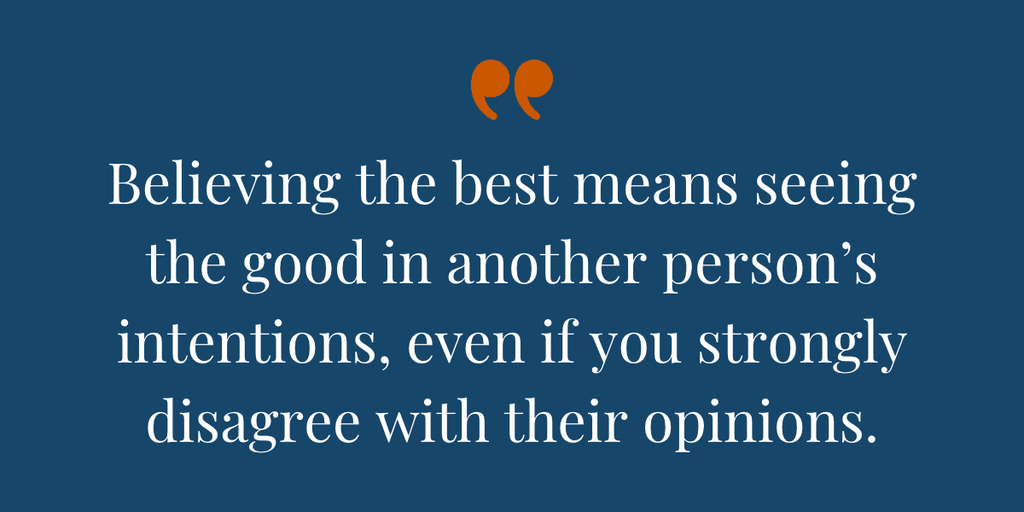
The second step is recognizing what “believing the best” actually means (and doesn’t mean). It means seeing the good in the other person’s intentions, even if you strongly disagree with their political or policy opinions. It means listening to your opinionated college fraternity brother describe donating to a cause that you think is very bad policy—but respecting that his underlying motivations are not bad. It means recognizing that he cares for others just as you do, that he wants what is best for the country just as you do, but that his background and beliefs lead him to a completely different idea of how to accomplish that.
This is an example of how “believing the best” is not about being “taken in” or being naïve. Believing that this person cares about others, for example, is almost certainly based on truth and is an essential starting point for loving someone well. After all, believing a lie about someone (a falsehood that they don’t care for others, or that they don’t want what’s best for the country) is almost by definition not loving them well.
Here’s the real obstacle under the surface. I think some of us have begun to have a knee-jerk feeling that by trying to understand someone’s perspectives and intentions, we are somehow implying that we agree with them.
We have to fight that fear and regain the lost art of respectfully listening to a point of view that we will continue to oppose. We are not listening out of respect for the opinion (since, after all, we disagree with it!) but for the person behind the opinion. And by listening, maybe we will get a bit closer to having the compassion that Jesus mentioned in Luke 6.
Now, to be clear, there will always be a small number of people we simply do not have respect for, based not on their beliefs but on their concrete actions. I cannot respect a political operative who knowingly spreads nasty falsehoods about my friend who is running for office. The caveat here is that we may start out with a desire to believe the best of someone… and realize upon examination that they are not worthy of it. But let us be sure that our view of the other person is based on their actual actions and character—not that we are assuming something about their character based on our views.
That leads us to the next step, which we will cover in part two.
In the meantime, let’s all go and do (if we haven’t already) one of the most important things that binds us together in this country: exercise our right to vote. And maybe, while you’re standing in line, listen with respect to the person next to you who is voting for the opposite party.
(If you want to try a more robust initiative, consider doing the 30-Day Kindness Challenge for someone in your life that you may disagree with but with whom you want to build a better relationship.)
If you are interested in having Shaunti bring research-based strategies, practical wisdom and biblical principles to your next event, please contact Amy Masaschi at [email protected]/.
On our podcast, I Wish You Could Hear This, Jeff and I offer proven steps to help you thrive in your life, faith and relationships. In other words, we’ll offer the practical help you’ve grown accustomed to right here in this blog space. You’ll take away specific steps that help you today. Listen, follow, and share with your friends on YouTube, Apple Podcasts, Spotify and other platforms.
Please note: This post may contain affiliate links. As an Amazon Associate we earn a small amount from qualifying purchases through these affiliate links. This doesn’t cost you anything, and helps us continue bringing you great content!
More from Shaunti’s Blog:
Could Venting Your Anger Actually Be Making It Worse?
Sometimes the worst thing you can do when you’re angry is talk about it. You probably just did a double…What Does Love Look Like When Life Is Wearing You Down?
This is the final part of a four-part blog series about loving people well in marriage, parenting, friendship, or any…How Do You Love Someone Who Is Losing Hope?
This is part three of a four-part blog series about loving people well in marriage, parenting, friendship, or any other…