

Could Venting Your Anger Actually Be Making It Worse?
Sometimes the worst thing you can do when you’re angry is talk about it.
You probably just did a double take at that. I’m sure that sentence sounds incredibly strange. (It sure was strange to write!) Especially since for years we’ve been encouraged to process emotions instead of suppressing them. And let’s be honest, when someone has really upset us, talking about it can feel pretty darn good…at first.
Maybe your husband said something that hurt your feelings, you’re having a hard time getting past it, and you’re sure your sassy friend will want to hear all the details—and have something to say about it! Or maybe you’ve had a frustrating conversation with a coworker, and you spend the entire drive home replaying it in your head, thinking of all the things you wish you’d said.
We’ve all been there. And most of us have assumed that getting those frustrations out will help us feel better. But have you ever noticed that sometimes, after twenty minutes of venting or replaying a conversation, you’re actually more upset than you were before?
Well, there’s a reason for that—and it’s a pretty convicting one. Research over the last decade or two has found that, contrary to what many of us have long believed, some of the ways we try to release our anger actually intensify it. And understanding why that happens is essential, since it can make a tremendous difference in how we handle conflict with the people we love—and in our own mental and emotional health
So here are three things worth remembering the next time someone pushes your buttons and the temptation to vent arises. (And if you’re a podcast person, you might want to listen to our podcast episode about this, too!)
1. Stop feeding your anger.
Back in 2002, a researcher at Ohio State University named Brad Bushman conducted a fascinating experiment. Participants wrote an essay and then received deliberately harsh criticism from someone they believed was another participant. The researchers then divided them into three groups. One group punched a punching bag while thinking about the person who criticized them. Another punched the bag while thinking about physical fitness. And the third group simply sat quietly for two minutes, having been told that they were briefly waiting while someone fixed something in another room.
Afterward, everyone had an opportunity to retaliate against the person who had criticized them. And guess what happened? The people who punched the bag while thinking about their anger were the most aggressive! The people who simply sat quietly were hardly aggressive at all.
A 2024 review of anger-management research reinforced this finding. Activities that increase our physical arousal generally aren’t effective at reducing anger, while activities that help us calm down are much more helpful. This should be common sense, but it goes against decades of assumptions about venting.
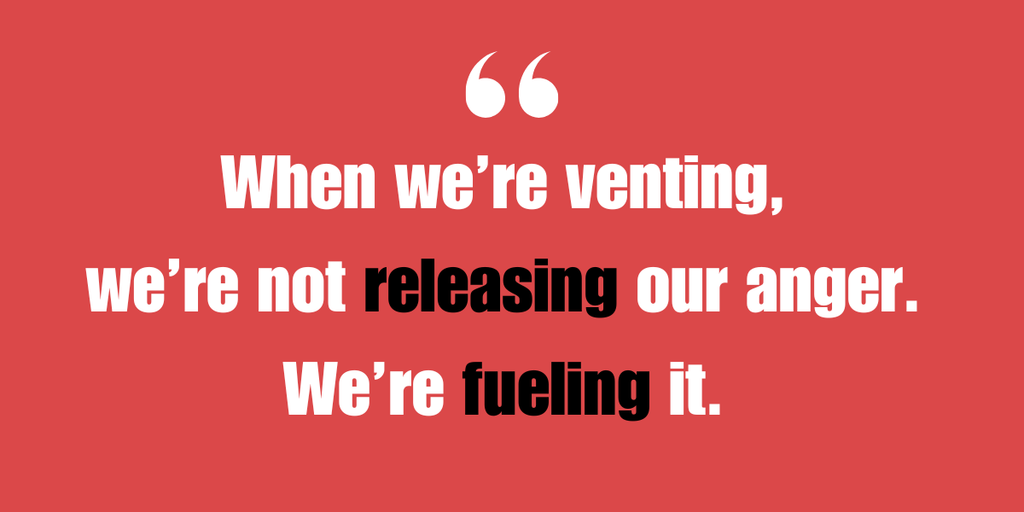
Think about how often we unknowingly keep our anger going. Maybe we stomp around the house, slamming cabinets because we’re frustrated with our spouse. Or we shoot off that angry email to the school (or about the school!), thinking that putting all of our frustrations into words will help us feel better. But instead of calming down, we find ourselves getting even more worked up! We aren’t “releasing” our anger—we’re fueling it.
2. Take steps to actively calm your nervous system.
One of the things I found particularly interesting about this research is how much our physical state affects our emotions. When we’re angry, our body’s fight-or-flight response kicks in. Our heart rate increases, our muscles tense, and we’re primed to react. And as you can imagine, that’s probably not the best state to be in when you’re trying to have a productive conversation with your overly emotional teenager!
As we discovered in the research with the most resilient people, for my upcoming book Habits of Hope, learning how to calm our bodies and minds is absolutely essential to regulating our responses well—and to a thriving life. Because when we learn to calm our emotions, we’re also building the hope and resilient habits we need to handle life’s challenges. (Shameless request for a favor: Please pre-order your copy so Amazon sees this book as worth including in their promotions!)
Fortunately, there are some very practical ways to help our nervous system settle down. Here are two that involve giving ourselves a little space to reset before reacting.
One is a technique called box breathing, which is used by first responders and others who have to remain calm under pressure. There are lots of different ways of doing this, but here’s a simple 60-second pattern: breathe in for four seconds, hold for four seconds, breathe out for four seconds, and hold again for four seconds. Repeat that cycle a few times. You can even do it discreetly while sitting in a tense meeting or listening to your teenager explain why they didn’t do what you asked.
And of course, there’s prayer. Sometimes we have to recognize when our temperature is rising—and let that awareness be the trigger that tells us to take a minute and ask God to help us see the situation clearly and show us how to respond wisely.
3. Change what you’re focusing on.
My husband Jeff and I actually experienced the power of this principle in our own marriage years ago, long before we understood the research behind it.
When I was turning 39 years old, Jeff decided to do something incredibly thoughtful. He spent an entire year secretly keeping a daily journal of my life, in order to give it to me as an amazing gift for my 40th birthday. (And this was especially amazing because Jeff will be the first to admit that he’s really not a “gifts” guy. But on this one…he hit it out of the park!)
However, because we had plenty of conflict in those years, sometimes he would sit down to write his daily entry while he was still frustrated about something that day. He wanted the journal to be honest, but he also realized the kids might read this someday and didn’t want them to think “Dad, you were kinda harsh!”
So to moderate how “harsh” the words on the page seemed, he began intentionally adding a few positive things after the angry summary. For example, he might add something he appreciated about me, despite whatever caused the argument.
And something remarkable happened. By the time he finished writing that positive add-on, most of his frustration had faded. In fact, he eventually found himself even doing it in real time in the middle of the actual frustration, as he thought about what he would write down later.
Years later, while conducting the research for The Surprising Secrets of Highly Happy Marriages, we recognized just how significant that shift had been for our relationship.
I wonder how many of us could benefit from practicing something similar. You don’t need to keep a daily journal for a year! But the next time you’re frustrated with someone, try also deliberately reminding yourself of something you appreciate about them. It may take some practice, especially when you’re really upset. But that simple change in focus will have a surprising effect on how you feel.
What we do with our anger matters.
Ephesians 4:26 tells us, “In your anger do not sin.” I love that distinction, because we’re all going to experience anger. As we mentioned in the podcast we did on this topic, sometimes we have very legitimate reasons to be upset, and there may be real issues that need to be addressed.
But we can learn to handle those moments well. And by changing what you do with your anger, you’ll find that you’re actively changing you.
If you are interested in having Shaunti bring research-based strategies, practical wisdom and biblical principles to your next event, please contact Amy Masaschi at [email protected]/.
On our podcast, I Wish You Could Hear This, Jeff and I offer proven steps to help you thrive in your life, faith and relationships. In other words, we’ll offer the practical help you’ve grown accustomed to right here in this blog space. You’ll take away specific steps that help you today. Listen, follow, and share with your friends on YouTube, Apple Podcasts, Spotify and other platforms.
Please note: This post may contain affiliate links. As an Amazon Associate we earn a small amount from qualifying purchases through these affiliate links. This doesn’t cost you anything, and helps us continue bringing you great content!
More from Shaunti’s Blog:
What Does Love Look Like When Life Is Wearing You Down?
This is the final part of a four-part blog series about loving people well in marriage, parenting, friendship, or any…How Do You Love Someone Who Is Losing Hope?
This is part three of a four-part blog series about loving people well in marriage, parenting, friendship, or any other…Do the People You Love Know You Believe in Them?
This is part two of a four-part blog series about loving people well in marriage, parenting, friendship, or any other…