

When Loving Someone Gets Frustrating: What Does It Mean to Never Give Up?
This is part one of a four-part blog series about loving people well in marriage, parenting, friendship, or any other relationship, based on the challenge and encouragement of 1 Corinthians 13:7.
Years ago, when Jeff and I lived in New York City, Tim Keller was our pastor. (It was a bit like sitting under C.S. Lewis every Sunday.) And I remember him saying something when he preached on 1 Corinthians 13 that made me look at this very familiar passage in a completely different way.
You know the passage. Love is patient. Love is kind. We hear those words at weddings all the time. But Tim pointed out that if we really understood the context of 1 Corinthians 13, we might not be quite so quick to quote it at weddings!
Why? Paul wasn’t writing those words to people who were loving each other well. The Corinthian church was struggling with division, selfishness, pride, and all sorts of other issues. Paul wasn’t giving them a beautiful description of love to carve into a decorative plaque and hang over the kitchen sink. He was showing them how far their behavior was falling short of it.
1 Corinthians 13 is a challenge for us to ask: Does that sound like me?
It’s safe to assume most of us think we are pretty loving people. After all, we know how deeply we feel love for our spouse, our children, our parents, and our closest friends. And regardless, I’m sure most of us try to show others the type of love mentioned here—agapē love, which is based on a choice to value another person and seek that person’s good, as God does, regardless of how we feel.
But the feeling and the intent can be a very different thing from actually loving someone well in everyday life.
I discovered the same disconnect years ago during the research for The Kindness Challenge. The entire premise of that project was that most of us value kindness—so we think we are kind! Yet we can be surprisingly blind to the little things we say and do that the people around us experience as actively unkind and negative.
The more I’ve thought about it, the more I’ve started to wonder: what if we’re just as blind when it comes to love?
That’s the question we’re going to be tackling over the next few weeks in a series I’m calling What Does Love Really Look Like? 1 Corinthians 13:7 in Life.
In this series, as we examine whether or not we’re loving others well, I want us to use Scripture as our measuring stick, rather than our feelings. Specifically, we’re going to look at the concluding verse of that section of Paul’s letter. A verse that has launched thousands of memes, Hobby Lobby decorations, and bumper stickers: 1 Corinthians 13:7, which says:
“Love never gives up, never loses faith, is always hopeful, and endures through every circumstance.” (NLT)
And we’ll start with those first four words: Love never gives up. Other translations say, “Love bears all things.” The Greek word is stegō, which has the implication of “bearing up under” something, or of closely covering a gap—for example, of covering a gap in a building so well that water cannot get in and rot the wood.[i]
At first glance, the “love never gives up” phrase sounds fairly straightforward. Most of us would probably say we haven’t “given up” on the people we love. We’re still married. We’re still parenting. We’re still answering our mom’s phone calls or meeting that friend for coffee. But what if giving up can happen long before we actually walk away from the relationship? What if we have started to let that gap get wider, and the water has started to seep in and soften the wood?
If we’re going to measure ourselves by God’s standard, we have to look beyond whether we’re still in the relationship and ask how we’re showing up in it. We also have to ask whether we are actually covering potential gaps in order to prevent problems. So let’s get very practical about what it might look like to love in that way.
1. To avoid giving up, get curious.
Suppose you’ve reminded your ten-year-old again to put his backpack by the door before bed. And the next morning? You find it on the floor of his bedroom.
You can sigh to yourself and think, Why do I even bother? He never listens. You can start the process of giving up on ever seeing change.
Or you can pause and ask, Why isn’t this working? Maybe “get ready for tomorrow” means something completely different in his ten-year-old brain than it does in yours. Maybe he needs a checklist by his door instead of another verbal reminder.
When we try to solve a problem one way, and it doesn’t work, it is all too easy to conclude that the person is the problem. So the next time you reach that point with someone you love, pause before deciding you already know what’s going on. Ask a question instead. What am I missing? Is there something I don’t understand? What would help this person respond differently?
Sometimes the problem isn’t that we’ve run out of options. It’s that we’ve run out of curiosity. And curiosity can look a lot like love.
2. To avoid writing someone off, separate the person from the pattern.
Here’s one way we can tell if we have started giving up: We start using words like always and never.
She always makes everything about herself. He never follows through. My teenager doesn’t care about anything. My sister is impossible.
Once we’ve subconsciously assigned someone a label like that, we start looking for evidence that proves us right. And we stop leaving room for that person to prove us wrong.
Love doesn’t require us to pretend frustrating patterns aren’t real. Some patterns need to change. But instead of telling your sister, “You never think about anyone but yourself,” try, “I want to be able to babysit when you need help; but when you made those plans without checking with me, I felt like my schedule didn’t matter.”
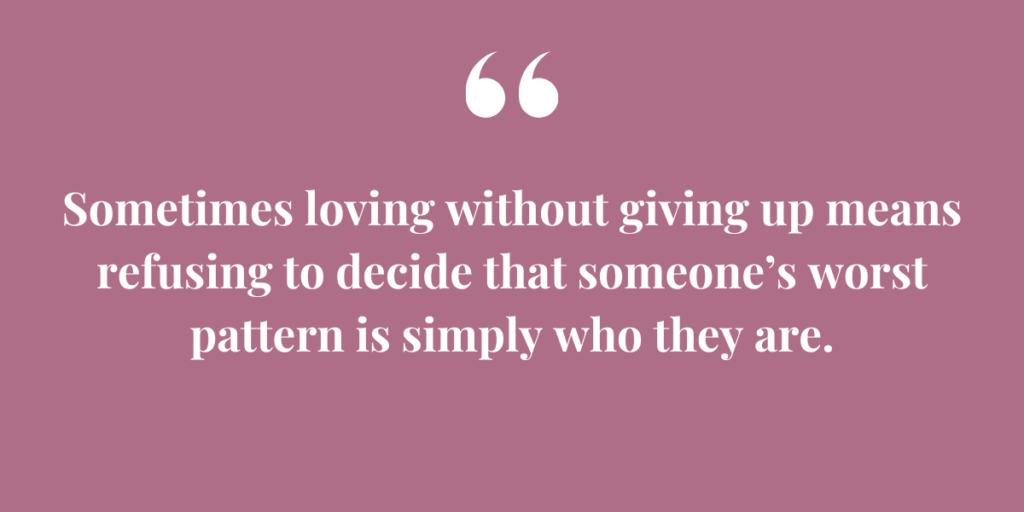
One condemns the person. The other addresses the problem while leaving room for growth. So pay attention to the labels you’ve subconsciously attached to the people you love. Sometimes loving without giving up means refusing to decide that someone’s worst pattern is simply who they are.
3. To avoid the temptation to stop trying, change what “trying” looks like.
Sometimes we give up because we’re exhausted from doing the same thing over and over—when what we’ve been doing may not be what is needed at all.
In recent years, we have had several friends who have lost spouses or other loved ones, or who have gone through other really difficult life events. And I’ve heard friends say (and thought myself), “I’ve asked so-and-so to let me know if they need anything, and they never do.” It is easy to sadly shrug and give up, right? If they won’t accept help, I guess there’s nothing we can do.
Well, as I was thinking about this topic, it occurred to me: Maybe I need to change what “trying” looks like. Maybe what we need to do instead is to text, “I’m dropping dinner at your door on Thursday. Would 5:30 or 6:00 be better?”
Another example is a harder one: Perhaps you have a relationship marked by someone’s addiction and poor choices and have consistently tried to protect the person from hard consequences. It sure becomes easy to give up, right? But maybe the way to avoid that is to change what trying looks like by setting boundaries and allowing those consequences instead.
Love can never force another person to change. But in the ordinary frustrations of life with imperfect people, 1 Corinthians 13 gives us a higher standard than I tried.
So this week, as you evaluate how you can love those closest to you well, ask yourself these questions: What haven’t I worked to understand? What label have I put on this person? And is there a different way I can love them this week?
Side note: If you’re engaged right now, learning to ask questions like these before marriage can make an enormous difference. Because even two people who deeply love each other can see the exact same situation very differently!
That’s why Jeff and I are hosting a free webinar called “5 Conversations Every Engaged Couple Needs Before Saying ‘I Do.’” We’ll help you talk through the areas that are important before you walk down the aisle. So if you’re engaged, I hope you’ll join us. And if someone you love is preparing for marriage, please send this their way.
For the rest of us, let’s go back to Tim Keller’s challenge and read 1 Corinthians 13 through a different lens this week. Not as a beautiful description of someone else’s love, but as a mirror for our own.
Because sometimes “love never gives up” looks very ordinary. It simply means we keep looking for the next way to love.
[i] Greek word definitions and background are drawn from the lexical tools available at BlueLetterBible.com and BibleHub.com.
If you are interested in having Shaunti bring research-based strategies, practical wisdom and biblical principles to your next event, please contact Amy Masaschi at [email protected]/.
On our podcast, I Wish You Could Hear This, Jeff and I offer proven steps to help you thrive in your life, faith and relationships. In other words, we’ll offer the practical help you’ve grown accustomed to right here in this blog space. You’ll take away specific steps that help you today. Listen, follow, and share with your friends on YouTube, Apple Podcasts, Spotify and other platforms.
Please note: This post may contain affiliate links. As an Amazon Associate we earn a small amount from qualifying purchases through these affiliate links. This doesn’t cost you anything, and helps us continue bringing you great content!